Thursday, January 6, 2011

How Sells Shoe String Licorice

APPLICAZIONE DELLA NORMA - CAP.7: REALIZZAZIONE DEL PRODOTTO

In the previous post I talked a bit 'requirements and registrazioni. Roba necessaria, ma ancora piuttosto noiosa.
Questa volta invece voglio cominciare ad addentrarmi nelle fasi più succulente del sistema di gestione applicato al GDR.
Per prima cose è bene far mente locale sulla definizione di Divertimento (ovvero il nostro prodotto). Cosa bisogna fare per generare il Divertimento, e far sì che sia soddisfacente?
Bisogna ripercorrere il processo di creazione del prodotto, che nella fattispecie è l’avventura giocata. Per semplicità analizziamo una singola avventura, ma i concetti si possono facilmente estendere se si amplia il campo di applicazione ad un’intera campagna.
A tutti i processi, incluso quello di realizzazione del prodotto, è possibile applicare una metodologia Plan-Do-Check-Act (PDCA). Per i non anglofoni Pianifica-Esegui-Verifica-Agisci.
“Che diavolo è?” direte voi. E’ un sistema che probabilmente ognuno di voi usa già almeno in parte, inconsapevolmente, nelle fasi di realizzazione e gioco di un’avventura.
Si tratta semplicemente di spaccare un processo in fasi per poterlo gestire e permetterne il miglioramento continuo.
Applichiamo il PDCA alla realizzazione del Divertimento.


Pianifica
Pianificare è importante, checché se ne dica. E’ compito principalmente del Master nella stesura di un’avventura, e dei giocatori nel fermarsi a riflettere prima di get into the game on what the motivations and behavior of its characters. Let us pause, however, the task of the Master, far more voluminous.
Plan once again does not mean producing tons of paper. It simply means to prepare, as a teacher prepares the lesson as a student preparing for an exam.
This may be the same (as in my case) by writing the adventure. I am one who plans a lot, and I do so in writing, to fix ideas, we are just a few Masters who scribble on paper to get an idea of \u200b\u200bwhere he wants to lead the adventure. For those who use ready-planned adventure is to understand and know the setting, context, the important moments of the form used. Planning means making fluid the game.
be clear that planning does not mean to draw a freeze-frame in which the convergence of forced choices of the players. It means only to prepare to manage the plot and assess the "probable roads" on which the story will go.
Over the years I have met who do not like Master plan, preferring to let the ideas arise spontaneously in the game, managing sessions, free-wheeling. If I agree that a Master should be able to handle unforeseen situations and narratives in the arm, but I believe that this should be the exception rather than the rule. Manage all
improvising adventure or a campaign usually brings in inconsistencies, to lose the thread of cause and effect events, to repeat simple patterns and stereotyped in the plots in the game simply because there is no time to think .
This is the heart of the matter. To produce quality adventure, which is the first brick of Fun, you have to stop and think.

Run
All set? So let's play!
tomes and tomes have been written about how you should conduct an adventure, how the players should play, etc.. The execution of a game is what is most treated outlines, so I do not feel dover aggiungere un granché. Il problema è semmai che si è scritto fin troppo solo su questo aspetto del gioco, sebbene sia consapevole che è il più importante dal momento che è dallo svolgimento che si ottiene il prodotto Divertimento.

Verifica e Agisci
La verifica e l’azione sono due fasi del processo di realizzazione del prodotto che permettono all’organizzazione di monitorare come vanno le cose e di intraprendere le necessarie azioni correttive o preventive , e di impostare i conseguenti progetti di miglioramento innescando il virtuoso ciclo del modello di sistema di gestione.
Nel nostro caso specifico si sovrappongono ai processi di Misurazione, analisi e miglioramento e Miglioramento continuo del sistema di gestione. Argomenti che tratterò esaustivamente nel capitolo seguente.

Thursday, December 30, 2010

Pokemon Platinum Rom Desmume Mac

APPLICAZIONE DELLA NORMA - CAP.4: REQUISITI E GESTIONE DELLA DOCUMENTAZIONE

Eccoci alle applicazioni pratiche: da questo post affronterò i contenuti dei vari capitoli della ISO 9001 nell’ordine in cui li ho presentati precedentemente, in modo da seguire la "ruota" mostrata nella figura che illustra il modello di sistema di gestione. Il primo passo riguarda proprio i requisiti del sistema e la gestione dei documenti.
Come ho già accennato nel primo articolo, i requisiti sono importanti per il Master, che deve mappare il processo di creazione delle avventure. Le inclinazioni di ogni giocatore devono essere prese in considerazione nella stesura delle sessioni. Dico probabilmente cose ovvie, ma puntualizzarle non fa mai male. Spesso capita di assistere a Master (e anche di questi sono pieni i forum) che progettano avventure "per sé stessi", dove viene appagato semplicemente il loro desiderio di creazione e narrazione, dove si cade poi nel railroading spinto. Le avventure di D&D non sono la stessa cosa di un romanzo fantasy superepico, dove l'autore gestisce tutti gli aspetti della trama. In un gioco di ruolo anche i giocatori possono e devono dare il loro contributo!
Detto questo, è importante in fase di progettazione sapere se i giocatori sono dei powerplayer o se preferiscono l’interpretazione pura, se adorano tirare i dadi o se si possono conduct games without even a test of skill. All these considerations affect in an important way in both the "finished product". The sessions should not only pleasure to those who lead, rather must be tailored to meet the expectations of all members of the group.

In Chapter 4 of the standard, it addresses the issue of documents of the system. You know all that mountain of paperwork and procedures that are normally associated with quality? Here, of course ...
Starting from the definition (in my own words):
Document: procedures / instructions that determines how to conduct a trial. These are living documents, subject to revisions, changes, etc.
Registrazione: modulo/evidenza in cui sono registrati i risultati dei processi.
Le procedure documentate rivestono un ruolo importante nell’implementazione di un sistema di gestione, ma questo non significa che per giocare a D&D servono tonnellate di procedure di gestione del gruppo! Anzi NON servono!
I documenti di sistema sono rappresentati dalle convenzioni verbali tra Master e giocatori e dai manuali di gioco stessi. Procedure scritte che descrivano "come fare le cose" servono solo se trovate che siano utili come promemoria, o per evitare malintesi con i giocatori.
Ad esempio, la regola del "Dado-cazzata" presentata qualche tempo fa, è un esempio di documento, perché accettata conventionally by all players (though not written anywhere).
speech different is that instead of records: Records are important to keep track of what happens in the group. The records represent the results of the various processes, from the construction of entertainment (eg write an adventure or a trace of itself), performance monitoring. Even the cards of the characters are records, recorded on forms that the findings from a process described in a paper system (ie, Player's Handbook).
Everyone can create recordings that considers more appropriate, and below and in later chapters will report some examples significant.

registry of events, missions and characters
After thirty years my memory is not what it once was. Misfires, I forget things ... and the same goes for players. "What was the merchant met two months ago in Tavistock? And the magician's pet cat?", "We had a mission on hold in Salamanca, but who had it carried?"
are all examples of questions that I wonder how many times have you faced. A log of events, missions and characters makes things much, it becomes in all respects a diary.
The register can be extremely simple, and report only the facts, or more detailed to keep in mind moods, feelings, moods generated by special events (you know, it is useful when writing a blog for delay of several months on the current state of the campaign ...)
Write your diary is demanding: it must be done immediately , a fresh mind. Also it takes time, it is undeniable, especially if the level of detail of description is high. Write the diary of a session can take 30-45 minutes away, a luxury for the master running out of time.
Yet it is very important. Better to create a stripped-down than not have it all. Something that does not steal more than 10 minutes to return to writing the important events of the game just taken place. A register of
events allows everyone to "wipe" if necessary, fixing on paper the story progresses. If a player misses a session, reading the diary will start operating immediately with the rest of the group. The Master Thanks to the diary can calmly assess the allocation of experience points or prizes, you can avoid running into inconsistencies with the events that have already happened, cause and effect mechanisms can be connected with past events and new adventures, and so on.
In my group of D & D myself to write the diary, since I also serve as the basis for the fictionalized account of the blog, but nothing that prohibits a player to keep track of the adventures of the group, the tasks to be addressed and characters not gambling.
greater involvement of the players, the more they feel part actively and responsibly in the management system: Another good solution could be to build the rotation of the diary, or a division of labor (I events, you NPCs. ..).
It follows that another important aspect of the register is accessible. The diary is not the prerogative of the Master or the author, and must be as accessible and integrated by all group members.
In this sense, Google offers a great service for sharing files (but not the only one), through which all players can see / edit the registry on the Internet freely.
Se si giocano campagne lunghe o se la frequenza di gioco non è assidua, vedrete che leggendo il registro degli eventi prima di ogni sessione sarà molto più facile "entrare in partita"!


Registro della progressione
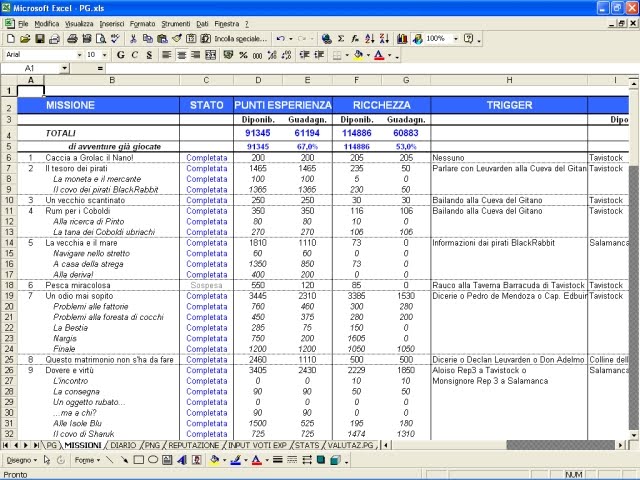
Il registro della progressione è un sistema di registrazione che utilizzo nella campagna di D&D per monitorare l’assegnazione di Punti Esperienza e denaro (sì, ho usato il verbo monitorare: chi ha familiarità con la norma avrà già capito che questo registro è anche un indicatore di performance). E’ uno strumento da Master, utile per registrare in modo statistico il progredire dei personaggi rispetto alle attese, e per pianificare il numero di "avventure per livello" che si vuol far affrontare ai giocatori.
Questo è uno screenshot del mio file. Credo che un’immagine valga più di mille parole. Su questo registro tornerò in seguito, quando parlerò di monitoraggio.


Sia chiaro che queste registrazioni possono essere gestite tramite file (se avete familiarità con excel o simili), ma nulla vieta di farsi una banale tabellina cartacea. E’ sempre importante ricordare che la norma prevede ciò che bisogna fare, non come bisogna farlo. Le registrazioni sono previste dalla norma, il loro formato no. Ognuno deve trovare il modo che più gli è consono per gestire le sue registrazioni, it is a complex spreadsheet calculations, links, and statistical analysis, whether it be a paper trail on which the Master record their data.